
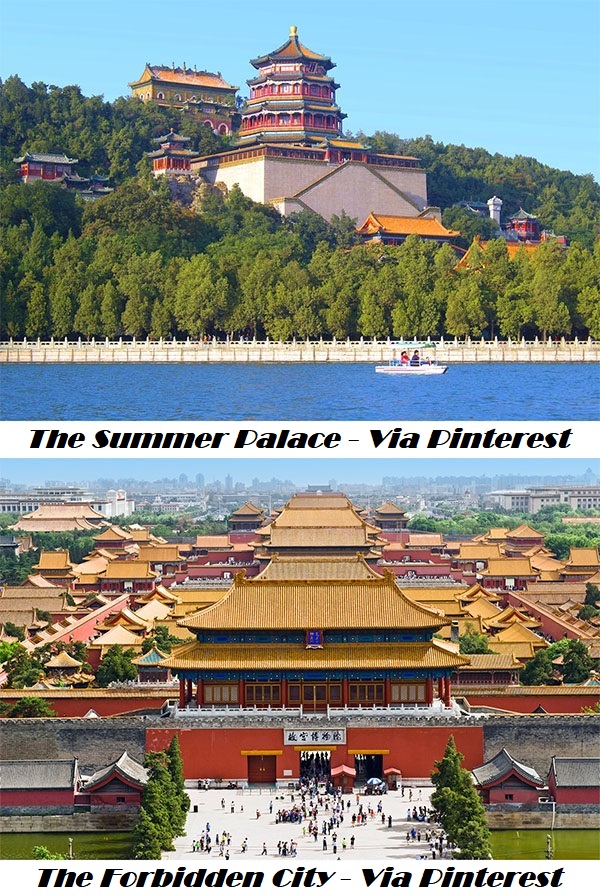
This practice has nothing to do with magic, although some people believe it creates miracles and has the power to transform your life in a blink of an eye. It is not mystics, nor magic, and neither a religion. This millennial practice originates from Chinese traditions applied consciously on architectural planning of living and working spaces to increase wealth and success in different life aspects. It is a gathering of beliefs and folk observations preserved from past generations, a set of rules helping to organize the house and its surroundings, another way, a set of skills helping to live harmoniously with yourself and nature. The Summer Palace of the Empress Cixi (Qing dynasty) and The Forbidden City palace complex in Beijing (from the Ming dynasty) were built following by word the rules of feng-shui.
Before initiating with cardinal changes and implication of the feng-shui rules, start cleaning out space, free yourself from all that is too old, that is broken, and that is of no use (all of that has negative energy). Afterward, divide your home into spaces according to the Bagua Map (the energy compass), that I will talk more in detail later. And only then resort to symbols and good-luck activators that feng-shui is proposing to embrace.
This practice will also help those who want to improve something in their personal lives and don’t know where to start. For centuries this science is studying what impact has a habitat on human life. According to feng-shui believers, when you are changing your lifestyle and home surroundings, you create a new energy flow that will directly impact your destiny. The house you live is seeing as an organism, where you (and your family lives here) at its heart and soul are you (and your family living here). Wise people practicing feng-shui for centuries are convinced that positive feng-shui at home, as good air, fresh products, and clear water, have a beneficial effect on a person living in harmony with nature and inclosing people. A house organized on feng-shui rules and is filled with benevolent energy brings good luck in its inhabitants' lives for at least five generations. Remember that this practice is only helping you get better perspectives and increase your chances on good wealth, but it is not a wizard’s magic wand, so correct your behavior and continuously work to improve your health and interpersonal relationships (meaning, that if you have a terrible character, feng-shui may help you encounter the partner of your dreams, but it will be of no long duration if you don’t work on your behavior and careless character).
In Chinese culture, a human’s destiny depends on three crucial components. First, it is the “heavenly luck” – it is decided from the above. It is how and where we come into this world, the family we born in, circumstances, time, place, health conditions, physique. This will be the foundation of our destiny: a child born in a banker’s family in New York, and a child born in a small village in the center of Africa, respectively, will have different backgrounds. Secondly, the “earthly luck”, depends on us, it is about our attitude towards the material world, how we engage with people around us, and nature itself. For example, people who uncaringly through garbage on the streets or vandalize beautiful objects, the energy of such people is smutty so that no good luck will follow them. Thirdly, we have “the human’s luck”, and it is all about how good each one of us can manage personal “earthy” and “heavenly” good luck to create. It is no surprise to see often how a person, who came into this world with great potential at its birth (heavenly luck), didn’t commit in developing its capacities (earthy luck), so ended into ruins after all; or the other way around, born in poverty, but being mindful and working hard, staying aware of the possibilities and having courage, managed to reach greatness in life. So, a “human’s luck” is mostly about a person's character and its wish and hard-working on achieving greatness. The summation of these three key-lucks will determine a human’s faith. The science of feng-shui in these schemes is part of the “earthy luck”, giving tools on how to improve the good faith. One last important aspect, just in case: do not use all the feng-shui techniques at once, but step by step, amplifying and modifying according to your personal life, habits, climatic conditions, and necessities, to create a balanced and harmonious living.
THE BASIC CONCEPTS OF FENG-SHUI
When you start to decorate according to the feng-shui principles, you suddenly understand that some of them have been applied before and did it in the right way. That’s because we, humans, have that “genetical memory” (others may call it “the sixth sense”) telling us instinctively what is right, a set of rules that we inherited from our ancestors through “traditions and customs.” It is essential to accept the customs and the vision of how the world exists through the Chinese culture, where the roots of feng-shui are. According to the Taoist worldview, a constant flow of energy is passing through the universe – it is the life-giving energy Qi (or Chi), that gives vital force to all the living souls.
The energy can be conducive or harmful for a person. Feng-shui principles intervene, offering methodic ways of protecting ourselves from the negative energy and preserving and increasing the benefic energy qi in our houses. Knowing how to accumulate energy qi will help you deal with disharmony and chaos and find the right way to interact with the outdoor world harmoniously. All the objects surrounding us have a color and a shape and carry specific energy by itself. Their energetic field influences, consciously or unconsciously, our mood, feelings, and well-being, and in the long run, it influences our lives. That is why the parameters of all the objects surrounding us have primary importance in feng-shui. It sees not merely as one’s personal preference, but more as an effective remedy, giving the tools to correct the energy – weakening or strengthening, but also by varying its quality.
In the feng-shui system, HAPPYNESS has a more profound and much more complex understanding – it requires a family must be accomplishing with success in all the eight fields of life: health, wealth, marriage & relationships, worthy progeny, reputation, career & life journey, knowledge & self-development and support of helpful/powerful friends. If any of these eight fields is not fulfilled, a family cannot be considered completely happy and accomplished. Being wealthy without a loving partner aside and mistrusting your partners in business cannot be regarded as a fulfilling living, the same a long life without good health cannot be seen as a happy life after all.
Every part of a house is responsible for one of the eight essential aspects of life. It is crucial to set every part of it, keeping in mind the symbolic meaning in feng-shui.
THE BAGUA MAP
When it comes to the Bagua concept, an occidental reader usually starts to get confused, but it is merely a scheme forming the base of feng-shui. Bagua, translated from Chinese, means “eight trigrams”, which is simply a graphical formula reflecting the universe's principles. A trigram – is the combination of three lines drawn one above the other. These lines can be intermittent or continuous, and each of them has a specific meaning. On the Bagua Map, each of the eight trigrams occupies an individual positioning based on the sense it is carrying. The interconnection gives it between chaos and order, sky and earth, Yin and Yang, five elements (fire, earth, metal, water, wood), and four cardinal points (North, South, East, West). In the center of it all stays the well-known symbol of interweaving black and white, the feminine Yin with the masculine beginning Yang.
The Taoist worldview believes that all the surroundings are created based on complementarity between two opposites – Yin and Yang. Yang is for the sky, sun, light, warmth, white color and refers to the left side. Being the opposite side of the Yang, Yin symbolizes the earth, moon, darkness, coldness, black and refers to the right side. For centuries, Chinese people say: “The qi of the sky and the earth, when coming together, create unity, and when sparing a part, are creating Yin and Yang.” Without Yin, there is no Yang, and without Yang, there can be no Yin. Only the harmonious interaction (balance) between the two beginnings can form favorable (procreative) energy.
Yin and Yang are two complementary beginnings, masculine and feminine. They contain each other and reaching its apogee, it crosses over, Yin becomes Yang, and Yang becomes Yin. In interior design, we must analyze inside the space of our homes: Yang – is for the rooftop, dry air, warm colors (red, yellow, orange, white), smooth surfaces, furniture on wheels, direct light, tall units, lightweight furniture, etc. Yin – is for the basement, humidity, cool tones (blue, light blue, black), soft paddings, low heavy furniture, muffled/muted lighting, etc. The right balance of the two beginnings and the interaction with the five primary elements attracts the flow of energy Qi.
From the center of Yin and Yang, eight trigrams are placed on a circle at equal distance. Each is related to a cardinal direction – South, North, East, West, South-East, South-West, North-East, and North-West. And each of them symbolizes one of the five elements - fire, earth, metal, water, wood. See the drawing below:

Why is the Bagua Map so important in the feng-shui? Practically, the eight trigrams help us understand how and where we can intervene to harmonize the space, direct the Chi energy to increase our well-being, and diminish or deviate the influence of the negative energy. To correctly distribute spaces and accordingly decorate them, an interior designer that practices feng-shui uses the Bagua map algorithm. With its help, we can adequately identify the meaning of every room/part of the house (apartment, office, a separate room, working desk, etc) and its influence on our well-being, health, financial success, and relationships. It helps us designate spaces to a particular use and maximize it; moreover, it helps to decorate it, creating a small universe based on the great universe's primary laws.
Eight trigrams, interacting with each other, form hexagrams (a combination of six such lines), which formed the basis of the oldest Chinese study “Books of change” (“I Ching”). It is hard to express the significant meaning of this book for Chinese culture. What is important to state is that from this book, we have the main philosophical categories and symbolics we use in feng-shui – Bagua, the “sky-earth-human,” the magical Lo Shu square, the concept of balance and harmony, the interaction Yin-Yang.
THE “MAGICAL” SQUARE LO-SHU
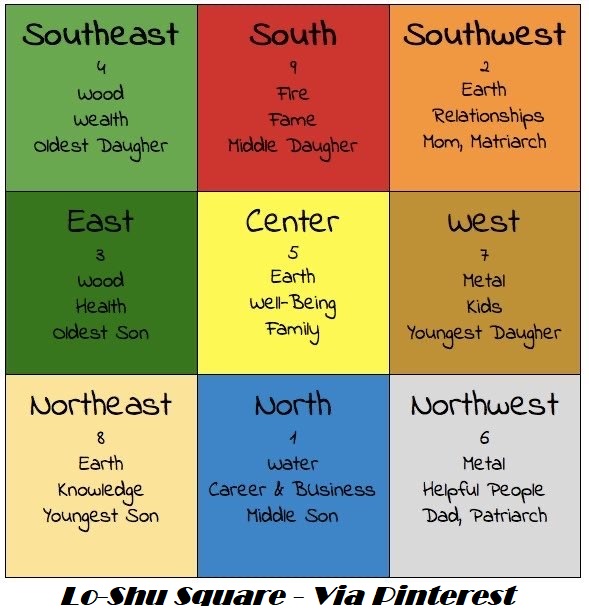
As already mentioned above, the “Books of change” holds a universal graphic language and formulas, explaining how the world has been created and how it works. Such a procedure is enhanced in the graphical model named the “magical square Lo-Shu”. The square divided into nine sectors, where randomly are placed numbers from one to nine, got the name “magical” not by chance – the sum of these numbers, taken horizontally, vertically, or diagonally – will always be fifteen.
THE FIVE ELEMENTS
The theory of five elements is another uncomprehensive moment for most occidental cultures, where, by tradition, are used to have only four elements – Fire, Water, Air, and Earth. However, for the feng-shui practice, even at its basic level, we need to embrace another perspective of the universe, which is not contradicting but complementing the European view.
The map of the universe seeing through the eyes of the millennial Chinese culture helps to understand the five elements' teaching and how they interact through time and space. There are five primary elements – Wood, Fire, Earth, Metal, and Water, and all that exists on the planet, organic or static, correlates with these elements. It directly applies to human beings too. The entire human body is divided accordingly, and even the emotions that we can feel are all divided into five types: anger (Wood), joy (Fire), thought (Earth), sorrow (Metal), fear (Water).
Following the balance between these five primary elements is the key to the “golden mean” – the base of it all, in art, science, medicine, culinary, or feng-shui. The five elements interact with each other in two ways (cycles) – the cycle of “creation” and the cycle of “destruction”. When elements are communicating in harmony one with another, around them rises procreative energy. The accumulation and correct distribution of this positive energy is the primary goal in the feng-shui practice. Simultaneously, when the energy balance is broken, feng-shui helps to find ways to correct the flow and eliminate leaks.
What is essential to understand is that the power of the five primary elements stays in their unity. When one element prevails upon all the rest or dominant, such conditions often lead to catastrophic consequences. Example: an uncontrolled flame may burn all around, while the absence of fire can lead to freezing.
The way these five elements interact with each other defines the quality of the energy Qi. It is important to remember two types of interaction between these elements:
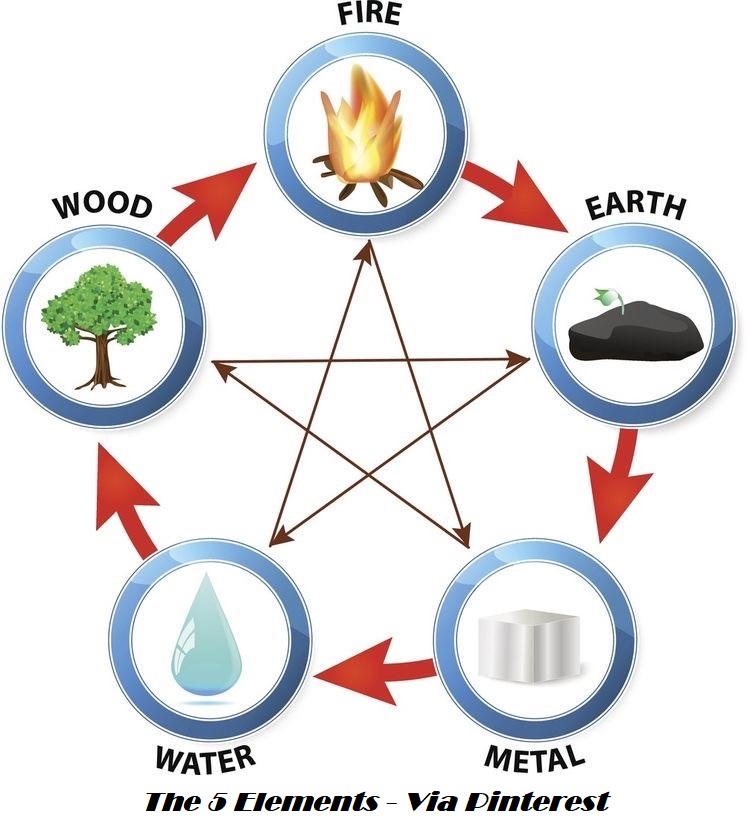
1/ In the CREATION cycle Wood “feeds” Fire, Fire in its turn – Earth, Earth – Metal, Metal – Water, and Water – correspondently supplies the Wood. Feeding/supplying, in this context, has the meaning of “having a positive impact” of an element over the other. Each last element gives life to the next element, having, at the same time, a destructive force over the other element.
2/ In the DESTRUCTION cycle Wood “eliminates” Earth, Fire – Metal, Earth – Water, Metal – Wood, and Water – Fire. In this case, “elimination/destruction” means that an element negatively impacts the other.
These elements incorporate the component's natural metaphysical properties and hold a deeper understanding of its symbolism and may have a different meaning in different situations. Moreover, each element has a particular shape and color; it refers to a specific season of the year, a specific person’s age, etc. For example, Spring – is referred to as the element Wood because the wood has the pursuit of knowledge. Summer – is related to the element Fire because fire is the expression of will and youthful activity. Autumn gets the power of the Metal because the metal is connected to intellect and the ability to survive. Winter comes to the Water element, associative with emotions, mood, and perception. The transition period between these four seasons is related to Earth's element because the earth can absorb and accumulate; it is about thoughtfulness and constancy.
Fire is considered the most powerful among the primary elements, a “yang” nature, the energy that brings success, particularly in the social and public sector. Its color is red; its shape is a triangle. Personifies energy, power, celebration. DIrection – South, associated with the sun and heat.
Wood is the only living element, according to which identifies growth, changes, and the beginning of a new life. It is considered to bring financial success, sustain personal development, and bring good luck. Its color is green, symbolizing life and good health. Its shape is a vertical rectangular. Direction – East, it is where the sun rises, and a new day/life begins.
Earth is also called “the heart” of feng-shui – its energy is considered the pledge of harmony in the house, family happiness, constancy, peace of mind, and protection from drastic changes. The coloring is varying among different shades of yellow, terracotta to browns. The shape is a square/cube, a steady and unchanged form. Direction – Center, South-West, and North-East.
Water in feng-shui is the synonym with the “energy of wealth”. On the one hand, this is a powerful energy, like fire, that leads to success and prosperity; on the other hand, it can reach a point when its power can be unguided and overflows. That is why water requires accurate and thoughtful handling; it is prone to ups and downs, “tides and retreats”. The color is blue and black. Its shape is a wavy line. Direction – North.
Metal is the symbol of mighty power. The right use of this energy leads to power. However, the surplus of this element suppresses free-will. The color is white, all shades of grey, silver, and gold. The shape is a circle/round. Direction – West and Nord-West.
The art of feng-shui is a unique example of an ancient set of beliefs passed through generations and seems to be unique, with no analogs among the European cultures. Although many cultures worldwide, living for an extended period on the same lands, have developed traditions. How to build and decorate homes, some “unspoken rules” becoming a cult and respected until our days (and about these, in details, I will share on another article).
Best wishes,
Nadiya
MetropolitanMe Blogger